A collaborative speaker series brought to you by:

Series
“Technologies of the Body”
Jun 08, 2026
8:00 - 9:30 AM PDT
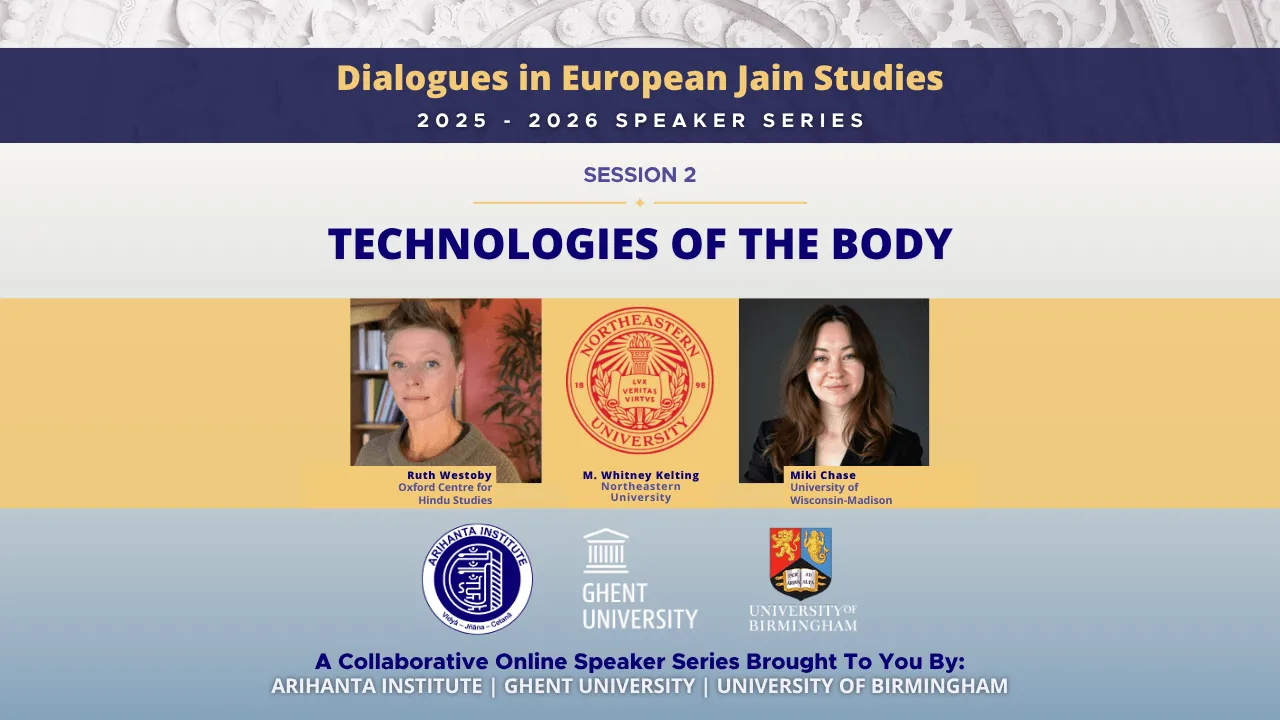
Presiding: M. Whitney Kelting, Associate Professor, Northeastern University
M. Whitney Kelting is an associate professor of religious studies at Northeastern University. Her book, Singing to the Jinas (OUP 2001), considers how the singing of Jain hymns grants Jain laywomen space for theological thinking and authority. Heroic Wives (OUP 2009) analyzes the complex negotiations laywomen traverse at the intersection of western India ideal for women and Jainism’s demands for laywomen. Her current book project centers on Jain masculinity and economic piety.
“Technologies of the Body”
Presenter: Ruth Westoby, Postdoctoral Research Fellow, Oxford Centre for Hindu Studies

Ruth Westoby is a researcher in South Asian Religions and a yoga practitioner. She is a Postdoctoral Research Fellow in Jaina Studies at the Oxford Centre for Hindu Studies, focusing on technologies of the body in Jainism and Yoga. As Affiliate Researcher at Inform, King’s College London and Associate Researcher at SOAS, University of London, Ruth researches asceticism and menstruation in yoga, tantra and neo-tantra. Her book project is Bloody Bodies: Stopping Menstruation in South Asian Religions. She teaches MA Yoga in the Modern World as Senior Teaching Fellow at SOAS. Her PhD from SOAS (2024), supervised by Prof. James Mallinson, explored The Body in Early Haṭha Yoga and was funded by CHASE-AHRC. She also collaborated with the SOAS Haṭha Yoga Project (2015-2020) interpreting early modern yoga postures, contributing to the emerging research methodology, ‘embodied philology’.
“Jain Technologies of the Body: Menstruation and Amenorrhea in text and context”
Non-harm (ahiṃsā) is one of the most important features of the Jain worldview. This principle has been applied with logical rigour to menstruation. In textual sources developed over the last two and a half thousand years menstruation is considered harmful in that living beings (jīva) in the menses are killed as a result of sex (Hemacandra’s Yogaśāstra 2.79) and when the blood leaves the body. Menstruation is considered voluntary in the sense that it is occasioned by feelings of desire or faults (kaṣaya) that are eradicated as one becomes more spiritually pure and progresses through the spiritual stages (guṇasthāna). In comparative context, there are hints towards stopping menstruation in the Haṭha Yoga corpus, and systematic accounts of spiritual amenorrhea in Chinese female-oriented inner alchemy (Nüdan). As yet, I have found no Jain textual sources describing how to stop menstruation or instructing women to do so. However, I have gathered stories through interviewing Jain women not only on views of menstruation but on examples of menstruators halting their menses for religious and spiritual purposes. This paper presents preliminary findings on Jain textual sources and lived religious anecdotes on menstruation and amenorrhea in Jain communities. I explore the religious affordances of non-menstruation and consider the implications for the gendered body in saṃsāra and the perfected (siddha) body.
Presenter: Miki Chase, Assistant Professor, University of Wisconsin-Madison

Miki Chase is Assistant Professor of South Asian Studies and Śrī Anantnāth Chair in Jain Studies in the Department of Asian Languages and Cultures at the University of Wisconsin-Madison. She received her PhD in Anthropology from Johns Hopkins University in 2022. Her research explores intersections of law, religion, and gender in the ethics of death and dying. Her current book project is an ethnographic study of women’s social negotiations of the ascetic disposition in sallekhanā, the Jain ritual fast unto death, tracing gendered norms through which Jain women embody doctrinal ideals within urban domestic life, medicalization of death, and shifting legal terrain in India. Her research has been funded by the American Institute of Indian Studies (AIIS) and the Wenner-Gren Foundation for Anthropological Research.
“Sallekhanā and Subtractive Ethics: The Jain Unmaking of the Body”
This paper approaches sallekhanā, the voluntary fast until death, as a distinctly Jain technology of the body oriented toward ontological subtraction. In Jain karma theory, bondage occurs through activity conditioned by the passions (kaṣāya), binding subtle material particles to the soul (jīva). Classical descriptions of sallekhanā as “thinning” or “scraping” articulate a terminal discipline in which the attenuation of bodily substance is aligned with the deliberate minimization of karmic accretion and the stoppage (saṃvara) and shedding (nirjarā) of existing karmas. Rather than an inertly passive withdrawal, the vow intensifies ascetic vigilance at the threshold of irreversible decline. The dying body becomes a potent final site of karmic modulation, its diminishing metabolism synchronized with the aspiration to diminish attachment. These dynamics position sallekhanā as a Jain technology of the body within a subtractive ethics, in which the fast functions as a kind of metabolic exit. In this light, death is not treated as a singular event but as a durational threshold, an extended ethical interval in which the dying body becomes the final terrain for the management of karmic entanglement. Furthermore, although the liberated soul is ultimately beyond sex, embodied existence is structured through sex differentiating karmas that render the fasting body irreducibly gendered while oriented toward transcendence of its condition. Sallekhanā reveals Jain technologies of the body as a subtractive mode of ethical embodiment in which sexed, metabolizing life is methodically contracted at the threshold of death, rendering the durational labor of dying the final and most exacting site of karmic release.